Duval County · 32250
The 1st-to-5th Street core: blower rattle, duct loss, cottage openings
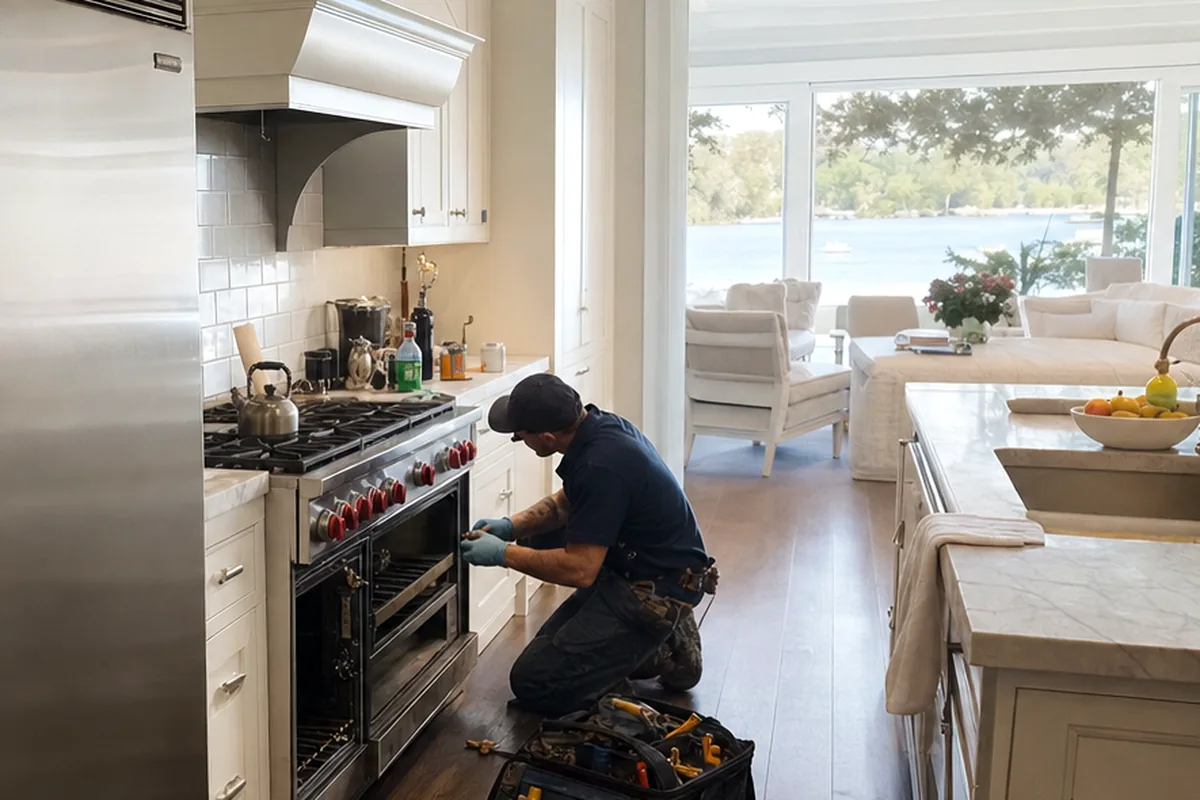
The numbered streets between the ocean and Third are the densest, oldest and most exposed part of Jacksonville Beach, and the appliances in them behave accordingly. This is the block-and-a-half band where a house can be close enough to a beach walkover that you can hear the surf from the kitchen. That proximity is the whole story of what we get called about here.
Direct exposure, not general coastal exposure
Salt aerosol does not fall off gradually with distance — it drops sharply, and then it keeps going a long way at a lower level. A kitchen on Second Street North is in the sharp part of that curve. A kitchen a mile west is not. The practical consequence is that the same Wolf hood, the same burner caps and the same stainless trim age at visibly different rates within the same ZIP code.
In this core we see the following on a shorter cycle than anywhere else we drive: blower wheels loading up and going out of balance, galvanised hood housing showing rust bloom behind the baffles, burner cap port rings pitting from the outside in, grate feet corroding where they touch the surface, and oven door hinge pins stiffening until the door stops pulling square against its gasket.
Houses on these streets also tend to keep sliders and windows open a large part of the year, which is exactly the habit that puts the most chloride through the kitchen. It is not a fault to be fixed. It is a maintenance interval to be set correctly.
Cottage kitchens, modern packages
The housing stock here is beach cottages, many of them heavily remodelled, and that produces a specific and recurring installation problem. A wall taken out, a new counter run, and a full built-in cooking package dropped into cabinetry that was never dimensioned for it.
What we find, over and over: a wall oven in an opening shallower than its specification, with the clearance behind it closed up so the trim sits flush. A cooktop over a drawer that blocks the air path the electronics need. A high-capacity hood in a house whose duct run was sized for something much smaller. Circuits shared where the appliance expects a dedicated one.
Each of those shows up later as a component failure, and the component gets blamed. A control board that cooks itself because it cannot shed heat will fail again after replacement unless the opening is corrected. We would rather tell you that at the first visit than sell you the same part twice.
The duct is the part nobody thinks about
Lots in the core are narrow, and a narrow lot decides the shape of a hood duct before anyone chooses a hood. The run usually has to turn to reach a side wall a few feet from the next house, or climb through a converted attic to a roof termination on a rebuild. Every turn costs airflow, and a retrofit that drops to a smaller diameter partway costs a great deal more than the owner expects.
The termination is worse, because it fails out of sight. A wall cap damper stiffens and stops opening fully, and a screen fitted to keep animals out fills with lint and salt crust. The blower then tests perfectly on the bench while the hood still fails to capture over the burners.
We check the duct and the cap on every ventilation call for that reason, before anything is quoted. A blower assembly fitted behind a throttled termination gives you a quieter version of the same complaint.
Access
Worth saying plainly, because it changes scheduling: the numbered streets have narrow lots, alley access on some blocks, and street parking that fills up from spring onward. Removing a built-in wall oven or pulling a range for a rear service access is a two-person job with a clear path. Tell us the model number off the rating plate and roughly how the kitchen is laid out when you call, and we will arrive with the right hands and the right parts rather than booking a second visit.
We are in this core most weeks, so the drive is short, and we carry the common ignition, hinge and blower parts on the van.
Money, before you book
What does a repair in The 1st-to-5th Street core usually cost?
The same bands apply here as anywhere else we drive — what changes on this stretch is how often corrosion turns a straightforward part change into a cut-and-remake job. Parts and labor together, quoted in writing.
| What gets replaced or put right | Usual range |
|---|---|
| Igniter or spark module replacement | $210–$550 |
| Burner valve or orifice service | $210–$710 |
| Oven thermostat or temperature sensor | $180–$520 |
| Convection fan or motor | $250–$680 |
| Diagnostic visit, credited to the repair | $80 |
Flat $80 diagnostic covering the visit and the full diagnostic sequence, credited toward the repair once you approve the work. A range rather than one number, because the firm figure is written down after the diagnosis and a range is what you can act on before it. The whole band table →
Owner reports
What owners in The 1st-to-5th Street core said afterwards
4.4 out of 5 from 79 published reports. Each one is a single visit, in the words of the person who paid for it.
Grease from years of griddle work had run down inside and one burner was starving for air. He stripped the top right back, cleaned it and reassembled without a mark. It behaves like a different appliance.
Amos W.
Only the two left positions would light. He found the spark module firing on half its outputs and swapped it. He also pointed out a perished knob seal that had been letting damp air into the control housing.
Elliot R.
Flames were licking up the front instead of sitting under the grates. He found the drip tray warped and the burner shields out of position, straightened what he could and replaced the one that had rusted.
Dorian K.
Questions
Asked about The 1st-to-5th Street core
Why does the duct matter so much in the numbered streets?
- Because the lots are narrow and the runs were fitted to the house rather than to a modern hood. A high-capacity blower pulling through a long, turned duct with a tired roof cap reads as a weak fan from the kitchen. We check the duct and the cap on every ventilation call there before touching the blower.
Can you get a built-in out of a cottage kitchen without damage?
- Usually, and access is the thing to describe on the phone. Say whether the appliance has to come out of its opening, what the doorway and the turn look like, and whether the counter overhangs it. That decides how many hands come and stops the first visit becoming a survey.
You talk about ducts here. Does that include the house ducting?
- Only the hood’s. A narrow lot decides the shape of a hood duct before anyone chooses a hood, and that run, its transitions and its wall cap are part of the appliance, so we measure and repair them. Ducting that carries heated or cooled air through the house is a different system and a different trade.
Book a diagnostic
Tell us the model and what it is doing. We come to the island, find the fault, and put the number in writing.
- $80 flat diagnostic, credited toward the repair
- You get a written estimate before any part is ordered or any labor begins.
- 90 days on labor, 365 days on parts
- Mon–Fri 8–6 · Sat 9–4 · Jacksonville Beach and the beaches