Wolf ranges
Sealed burner won't light, or lights late
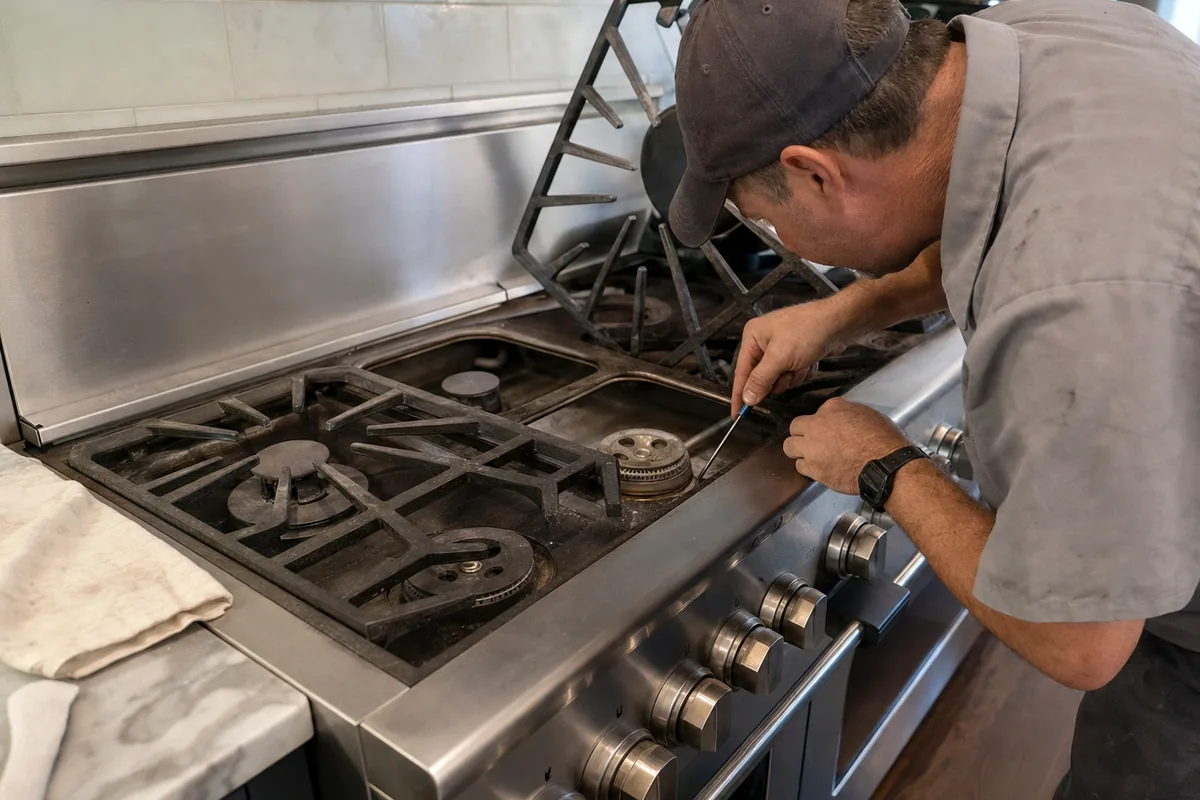
A sealed burner that will not light is almost always a spark path problem, a port problem, or a gas-delivery problem, and out here the first two are usually caused by the same thing: salt.
What we find on the island
The igniter electrode sits in a well that collects everything that boils over, plus the chloride that rides in on the wind. Corrosion on the electrode tip or a salt-and-grease bridge across the ceramic gives the spark an easier path to ground than the burner cap. You hear a healthy click but the flame never establishes. On a range that has been in a beach kitchen for a few seasons, we often find the electrode itself pitted rather than just dirty.
Burner caps are the second failure. The port ring pits from the outside in. Once the ports lose their shape the flame runs yellow, leans, and lifts off the cap at high flame. A yellow flame on a properly adjusted range is not a “needs cleaning” problem — it is a burner that is no longer metering air and gas the way it was machined to.
Third is simple: the cap is off its seat. Grates get pulled for cleaning, caps go back a few degrees out of register, and the burner will not light at all. Worth checking before you call anyone.
Gas delivery, when the spark is fine
If the spark is healthy at every electrode and the caps are sound, the problem is on the gas side. We measure manifold pressure with burners running rather than at rest, because a supply that reads correctly with nothing lit can still sag when three burners are open. A regulator that has drifted, a partly closed shut-off left that way after other work, or an undersized run to the appliance all show the same way: burners that light but will not hold a low flame, and one burner going out when another is turned up.
Where a single burner is affected and its neighbours are not, the valve for that burner is the suspect. Valves stiffen in coastal kitchens, and a stem that no longer moves smoothly through its travel will not meter the small, stable flow the simmer setting needs.
Clicking that will not stop
If the spark module keeps firing after a burner has lit, the module is seeing a short somewhere in the harness — often moisture or salt film across a switch body. That is a repair, not a habit to live with: continuous sparking wears the module and the electrodes.
What the visit looks like
We check spark at each electrode, resistance through the harness, cap and port condition, and gas pressure at the manifold before quoting anything. Most ignition faults resolve with an electrode, a cap set, or a spark module. Parts are ordered genuine, and you approve the written number before we order.
What you can check before calling
Two things, both free. First, lift each cap and set it back down squarely on its seat — a cap a few degrees out of register will stop a burner lighting entirely, and it is the single most common thing we drive out for. Second, look at the electrode tip and the white ceramic around it with a light. If the ceramic is glazed with a film of grease and salt, the spark is going to ground across it rather than jumping the gap, and cleaning it carefully with the gas off can restore ignition.
If neither helps, stop. Everything past that point involves gas under pressure or mains voltage at the spark module.
Never attempt a gas repair on a lit appliance, and if you smell gas at the range, shut the supply off at the valve and step outside before you call.
Money, before you book
What does this repair usually cost on a Wolf range?
Most of what we are called out for on this island lands between $210 and $710, parts and labor together, once the panel is off and the fault is known.
| What gets replaced or put right | Usual range |
|---|---|
| Igniter or spark module replacement | $210–$550 |
| Burner valve or orifice service | $210–$710 |
| Diagnostic visit, credited to the repair | $80 |
Flat $80 diagnostic covering the visit and the full diagnostic sequence, credited toward the repair once you approve the work. A range rather than one number, because the firm figure is written down after the diagnosis and a range is what you can act on before it. The whole band table →
Owner reports
What owners said after this repair
4.4 out of 5 from 79 published reports. Each one is a single visit, in the words of the person who paid for it.
The rear burner sparked but never caught, even with the knob held down. Salt had eaten the electrode tip back to nothing. He fitted a new one, then reset the gaps on the others while he had the top open.
Corinne B.
Our simmer burner clicked forever before catching and sometimes flashed back at us. The ports were partly closed with a crust of salt and grease. He soaked and cleared the cap, and it lights on the first click.
Bruce O.
After a week of rain none of the front burners would catch. He dried the switch bank out, replaced one that had already pitted, and traced a damp path coming in round the knob shaft, which he then sealed.
Ellery W.
Questions
Asked about this fault
Why does the igniter keep clicking after the burner has lit?
- Because the switch that starts the spark is not releasing. A boil-over that ran into the switch bank, or a knob seal that has perished and let damp air into the control housing, will both do it. It is a real fault rather than a quirk: the spark module runs continuously and pits its own contacts.
Is a yellow, lopsided flame the same fault as no flame at all?
- No. Yellow and lopsided is a port and cap problem — a crust of salt and grease closing part of the drilling, or a cap seated crooked after a clean. No flame at all is a spark path or a gas delivery problem. They are different repairs, and the second is the one to stop using the burner over.
What does ignition work usually come to?
- Electrode and spark-module work sits in the $210–$550 band, parts and labor together. Where a valve or an orifice has to come out instead, the range widens to $210–$710. The $80 diagnostic comes off whichever it turns out to be once you approve the written estimate.
Book a diagnostic
Tell us the model and what it is doing. We come to the island, find the fault, and put the number in writing.
- $80 flat diagnostic, credited toward the repair
- You get a written estimate before any part is ordered or any labor begins.
- 90 days on labor, 365 days on parts
- Mon–Fri 8–6 · Sat 9–4 · Jacksonville Beach and the beaches