Wolf outdoor grills
Outdoor grill: ignition, uneven burn, seized hardware
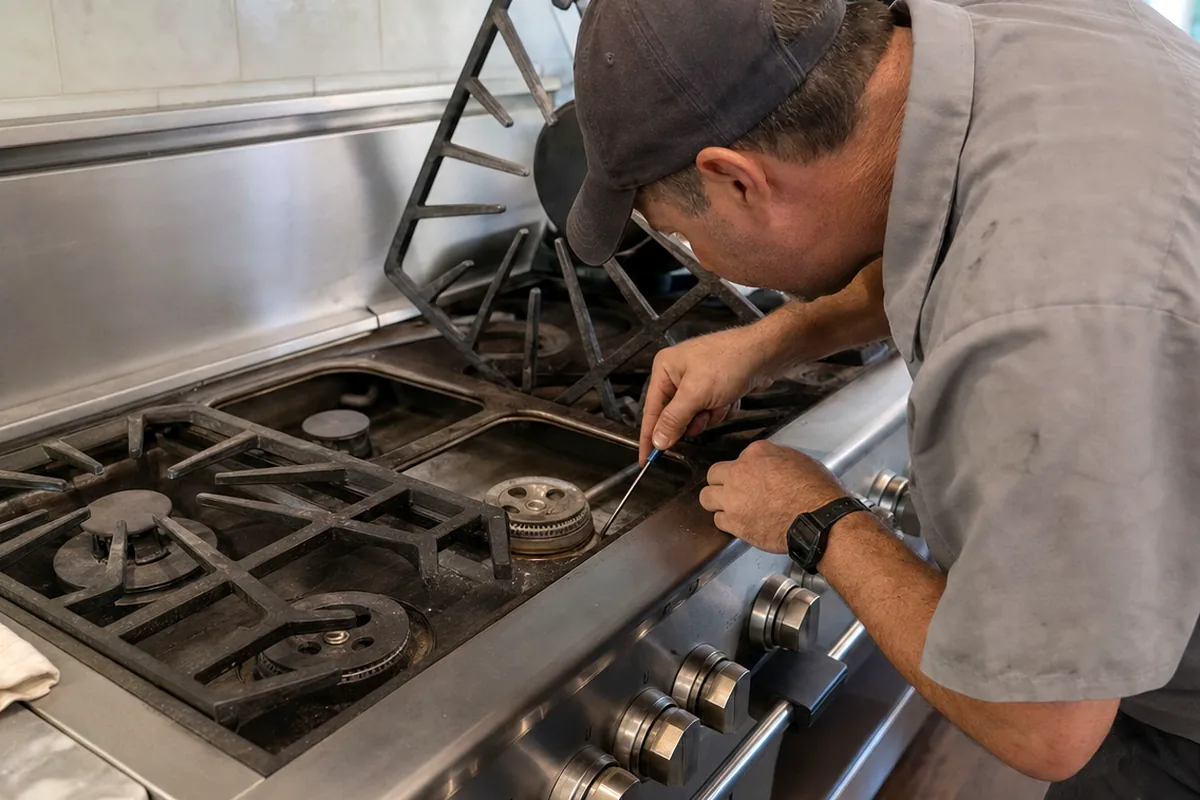
Outdoor kitchens are common here — far more common than a few miles inland — and an outdoor grill on the barrier island lives in the harshest environment any appliance on the property will see. It gets salt aerosol continuously, it gets rain, it gets condensation every night, and unlike the indoor equipment it never gets the benefit of a conditioned room.
Ignition
Grill ignition is the same physics as an indoor sealed burner and it fails the same way, only faster. The electrode needs a clean tip, a clean ceramic insulator and a solid ground to the burner. Salt film across the ceramic gives the spark an easier path to ground than the gap it is supposed to jump: you hear a healthy click and get no flame.
Where a grill uses a hot-surface or flame-sensing arrangement rather than spark, the failure is usually the sensing element or its connection rather than the igniter itself. Either way, the fix starts with inspection, not parts.
The other frequent cause is a burner whose crossover or carryover path is obstructed. One burner lights, the next never does, and the ports between them are blocked with carbonised grease or spider nest — genuinely one of the most common outdoor gas faults there is, and it costs nothing to check.
Uneven or yellow burn
Yellow, lazy flame on a grill means the air-gas mix is wrong. Obstructed ports, a partly blocked venturi, or a burner that has corroded through somewhere along its length will all do it. Stainless burners in a coastal outdoor kitchen do corrode through eventually. When they do, gas escapes below the port line, the flame pattern goes wrong, and the burner is replaced rather than cleaned.
On an infrared burner, patchy glow means a fouled or cracked emitter. Grease that has carbonised into the face changes both how it lights and how it radiates.
Seized and corroded hardware
The part of an outdoor grill repair nobody anticipates is the fasteners. Screws, clips and shafts that spent three years in salt spray do not come apart willingly. Valve stems stiffen. Hood hinges and spring assemblies bind. Drip trays and grease pans rust at the folded seams first, because that is where water sits.
We plan for this. It is also why we are honest about the point where a grill cabinet is too far gone to be worth further parts: when the frame itself has lost section, new burners will not save it.
What actually extends the life
- Use a proper cover, but only on a fully cooled grill, and lift it after rain rather than trapping wet against the metal.
- Rinse the exterior with fresh water on a routine. Salt that is rinsed off does no harm; salt left to cycle wet and dry does.
- Burn the grill hot for ten minutes after cooking, then brush the grates while they are still hot.
- Pull and wash the drip tray far more often than you think you need to. It is the first thing to perforate.
- Once a season, take the grates and heat diffusers out and look at the burner ports with a light.
What the visit looks like
We check supply pressure and the regulator, spark and ground at every electrode, port and crossover condition, burner integrity along its full length, valve action, and the state of the cabinet and hardware. You get a written estimate before any part is ordered, genuine OEM parts, and a clear answer on whether the unit is worth the spend.
Never work on a gas grill with the supply live, and if you smell gas at the cabinet, shut it off at the valve before anything else.
Money, before you book
What does this repair usually cost on a Wolf outdoor grill?
Most of what we are called out for on this island lands between $210 and $1,160, parts and labor together, once the panel is off and the fault is known.
| What gets replaced or put right | Usual range |
|---|---|
| Igniter or spark module replacement | $210–$550 |
| Burner valve or orifice service | $210–$710 |
| Control board or touch panel | $450–$1,160 |
| Diagnostic visit, credited to the repair | $80 |
Flat $80 diagnostic covering the visit and the full diagnostic sequence, credited toward the repair once you approve the work. A range rather than one number, because the firm figure is written down after the diagnosis and a range is what you can act on before it. The whole band table →
Owner reports
What owners said after this repair
4.4 out of 5 from 79 published reports. Each one is a single visit, in the words of the person who paid for it.
Only the side burner would light and the main pair stayed dead. He found the manifold union weeping and the orifices half closed with corrosion, fitted new ones and leak tested the whole run before he packed up.
Odette V.
Two knobs had seized solid out on the deck. He stripped and regreased the valve stems rather than replacing the whole manifold, which is what the last company out here had quoted me for.
Landon F.
Flames were licking up the front instead of sitting under the grates. He found the drip tray warped and the burner shields out of position, straightened what he could and replaced the one that had rusted.
Dorian K.
Questions
Asked about this fault
Is an outdoor grill really different from the range indoors?
- On this island, yes. A grill on an open deck takes salt aerosol with nothing between it and the water, and nothing ever rinses it off. Burners, valves and igniter leads corrode years faster than the same parts under a roof, so tell us on the phone that the appliance is outdoors — it changes what goes in the van.
The knobs have seized. Can that be fixed or is it a new grill?
- Valve work is often still worth doing. Stiff knobs are usually the valve stem rather than the knob, and a stem can be serviced or the valve replaced while the cabinet stays where it is. What ends the conversation is structure: when the frame or burner box has lost section, a repair is buying a season.
What does grill ignition work cost?
- Igniter and spark work sits in the $210–$550 band. Burner, valve or orifice work runs to $210–$710, because seized hardware on the coast usually has to be cut rather than turned. The written estimate follows the diagnosis, not the phone call.
Book a diagnostic
Tell us the model and what it is doing. We come to the island, find the fault, and put the number in writing.
- $80 flat diagnostic, credited toward the repair
- You get a written estimate before any part is ordered or any labor begins.
- 90 days on labor, 365 days on parts
- Mon–Fri 8–6 · Sat 9–4 · Jacksonville Beach and the beaches