Duval County · 32250
South Jacksonville Beach 32250: sealed houses, hoods with no air to pull
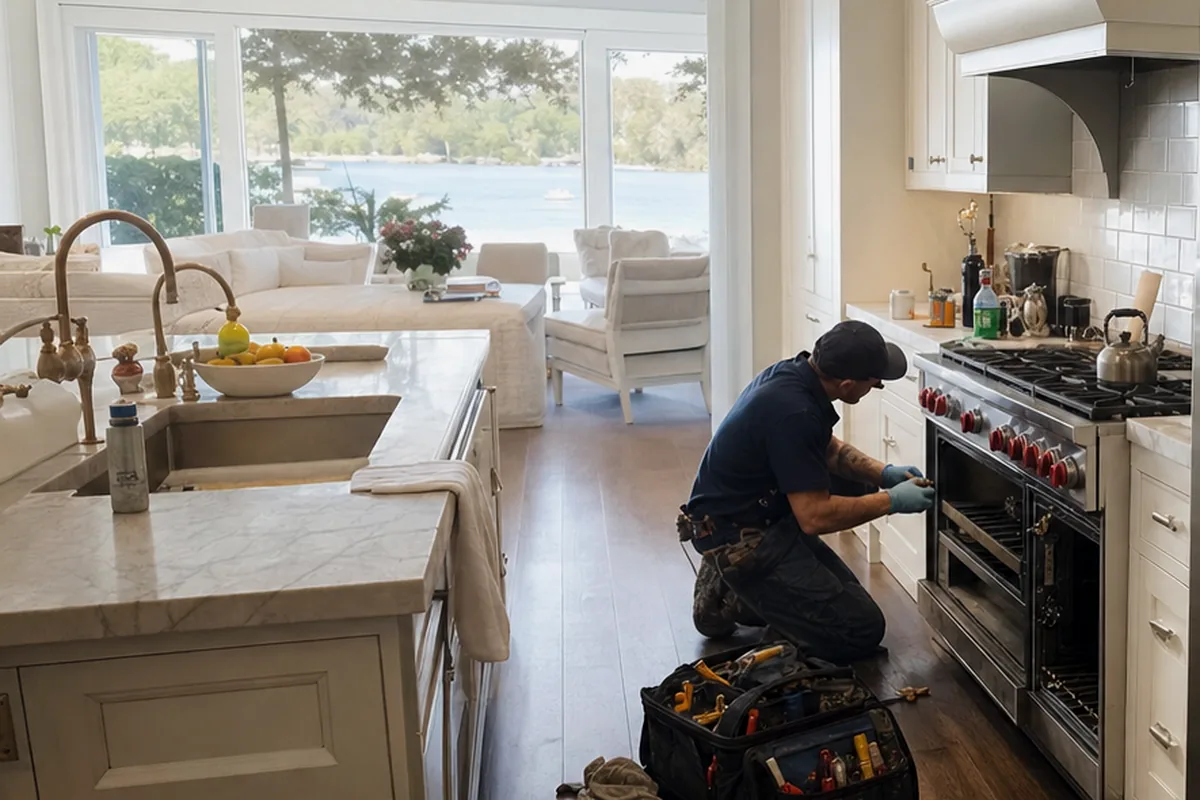
South Jacksonville Beach carries a heavier share of newer construction than the numbered-street core to the north, and that changes what breaks and when. The salt is the same and the ocean is the same distance away, but the houses are built to a different standard of tightness and the kitchens were specified all at once.
Everything went in the same week
In a cottage that has been remodelled over three decades, the appliances have different ages and fail on different schedules. In a house built with a complete built-in cooking package, the range or rangetop, the wall oven, the steam oven, the warming drawer and the hood were all installed within days of each other and have all run the same number of hours since.
They therefore tend to reach the same wear points in the same year. We routinely take a call about a hood blower here and end up looking at a steam oven that is two descales overdue and a wall oven whose hinges are stiffening — not because anything unusual has happened, but because the whole package hit its interval together.
It is worth planning for. A single visit that inspects the package as a package is cheaper than three separate call-outs six weeks apart.
Tight houses and hoods that cannot breathe
The most distinctive fault in newer construction on this end of the island is make-up air. A modern beach house is sealed properly. A high-capacity ventilation hood is designed to exhaust a lot of air, and it can only exhaust what the house can replace. In a leaky 1940s cottage the replacement air arrives by accident through the building envelope. In a tight new build it does not.
The symptoms read like an appliance fault: the hood sounds loud but does not capture, steam rolls out past the front lip, and the fan seems to be working hard for nothing. The hood is fine. The house is winning. That is an installation and ventilation-design issue, and knowing which of the two it is before spending money on a blower assembly matters.
The same tightness cuts the other way for corrosion, though, and in the household’s favour. A closed, conditioned house two streets back from the water puts far less chloride through the kitchen than an open cottage on Second Street. The hood still draws outside air across bare metal every time it runs — that exposure is unavoidable — but the burner caps, grate feet, stainless trim and hinge pins in a sealed house here age noticeably slower than they do in the core.
The quiet two: warming and microwave drawers
New packages down here almost always include a warming drawer, a microwave drawer or both, and they are the appliances nobody thinks about until they stop. They fail in ways that are easy to misread.
A drawer that will not run at all is usually an interlock rather than a dead appliance. Both types use a switch to prove the drawer is properly closed, and a runner that has picked up grit, a rack loaded heavily on one side, or a slide that has been racked slightly out of square will hold that switch just off its contact. The display behaves normally and nothing happens.
A warming drawer that runs but never gets there is a different problem: an element, a thermostat or a control that has lost calibration, and telling those apart is a resistance measurement rather than a guess. A microwave drawer that runs and does not heat is a high-voltage system, and the door interlocks on it are a safety system, not a convenience — nothing about that assembly is a homeowner job.
Both live in the same cabinet run as everything else, which means both are subject to the same clearance problem as the rest of the package. A drawer boxed in on three sides runs hot for its whole life.
Outdoor kitchens
The rate of outdoor cooking equipment down here is high, and outdoor equipment lives in the worst environment on the property: salt aerosol, rain, and condensation every night with no conditioned room to dry it out. Grill burners corrode through, crossover ports block, valve stems stiffen, and drip trays perforate at the folded seams first.
If you are booking us for something indoors, it is usually worth having the outdoor equipment looked at in the same visit rather than waiting for it to fail in the middle of a weekend.
Money, before you book
What does a repair in South Jacksonville Beach usually cost?
The same bands apply here as anywhere else we drive — what changes on this stretch is how often corrosion turns a straightforward part change into a cut-and-remake job. Parts and labor together, quoted in writing.
| What gets replaced or put right | Usual range |
|---|---|
| Igniter or spark module replacement | $210–$550 |
| Burner valve or orifice service | $210–$710 |
| Oven thermostat or temperature sensor | $180–$520 |
| Convection fan or motor | $250–$680 |
| Diagnostic visit, credited to the repair | $80 |
Flat $80 diagnostic covering the visit and the full diagnostic sequence, credited toward the repair once you approve the work. A range rather than one number, because the firm figure is written down after the diagnosis and a range is what you can act on before it. The whole band table →
Owner reports
What owners in South Jacksonville Beach said afterwards
4.4 out of 5 from 79 published reports. Each one is a single visit, in the words of the person who paid for it.
The right pair of zones dropped out under load while the left pair held. He isolated one power board and swapped it, then ran both sides hard with full pans in front of me before he would call it done.
Emmett G.
After a tropical storm the whole top refused to spark. He dried out the switch bank, replaced two switches that had already pitted inside, and told me straight which of the others would probably follow next season.
Ronan K.
The controls locked out and would not clear however I pressed them. He found moisture had wicked under the glass from a spill along the front edge, dried the assembly out properly and resealed it.
Basil R.
Questions
Asked about South Jacksonville Beach
Everything went in at once. Does that mean it fails at once?
- It means the package ages together. In the newer houses the range, the hood, the wall oven and the drawers were installed in the same week, so the second failure tends to follow the first by months rather than years. Knowing that changes what we look at while the panel is already off.
Why does a newer, tighter house give the hood trouble?
- Because a hood can only exhaust the air it can replace. A sealed house with no deliberate make-up air path starves a high-capacity blower, and the kitchen reads that as a weak fan. It is an installation and ventilation-design question rather than an appliance fault, and telling the two apart is the job.
If make-up air is the problem, is that still your job?
- Half of it is. Proving that a sealed house is starving the blower is our diagnosis, and we do it with a static-pressure reading rather than an opinion. Cutting in a make-up air path is installation work for an HVAC contractor. You get the measurements in writing to hand to them.
Book a diagnostic
Tell us the model and what it is doing. We come to the island, find the fault, and put the number in writing.
- $80 flat diagnostic, credited toward the repair
- You get a written estimate before any part is ordered or any labor begins.
- 90 days on labor, 365 days on parts
- Mon–Fri 8–6 · Sat 9–4 · Jacksonville Beach and the beaches