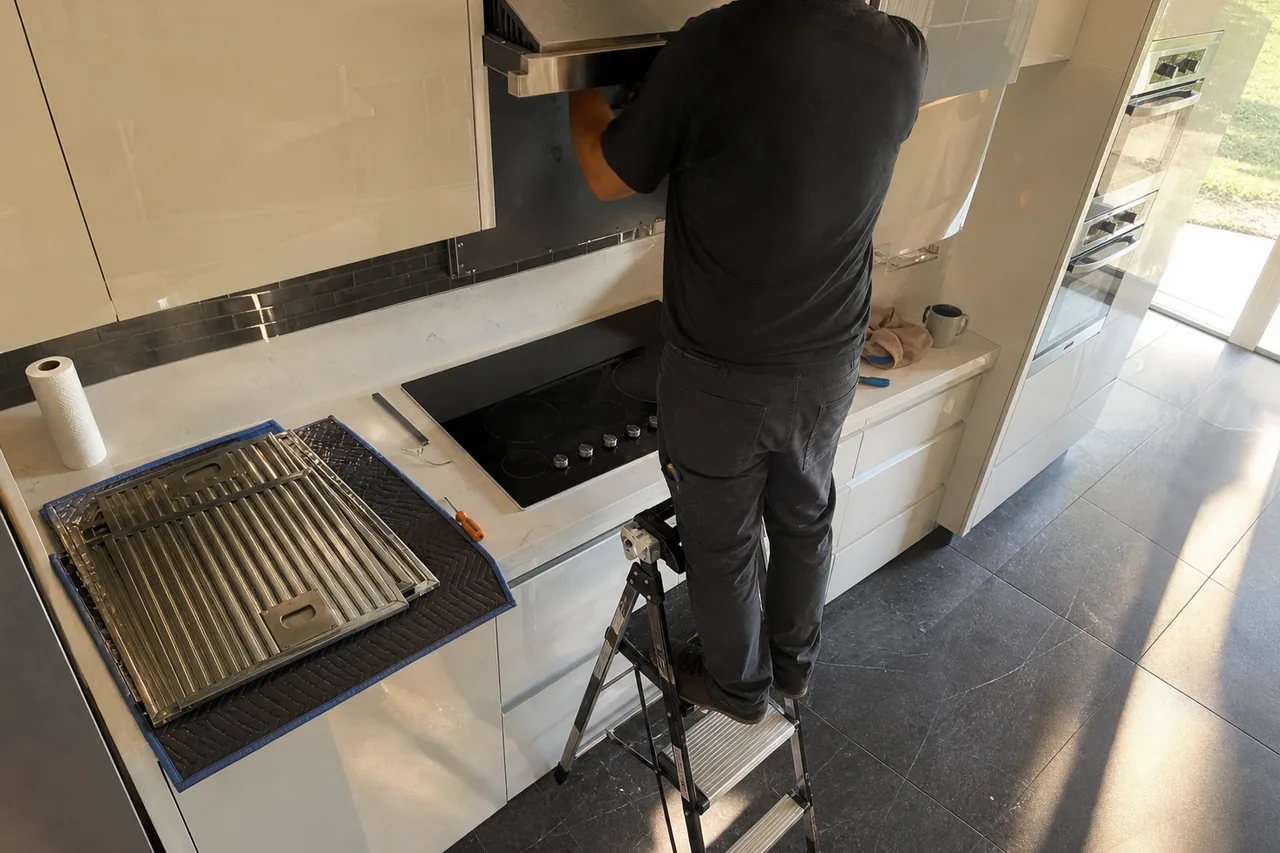
Wolf range hood cleaning is mostly about the parts that trap grease: the filters and, on pro hoods, the spacers and grease cups. Wolf’s interval for those is every 3 to 6 months, and all of them are dishwasher safe, so the routine is to lift them out, run them through a hot cycle, wipe the inside of the canopy and refit everything before the blower goes back on. The one firm rule is that the hood must never run without its filters, because the grease they catch would otherwise go straight into the blower and the duct.
Know which hood you are cleaning
The model prefix tells you what kind of hood sits over your cooking surface. VW marks a cooktop wall hood, VI a cooktop island hood, DD a downdraft, PW a pro wall hood, PWC a pro wall chimney hood, PI a pro island hood and PL a pro hood liner.
Pro hoods use stainless baffle filters. A PW302418 wall hood takes baffle filter 811180, which measures 11-7/8 by 11-7/8 inches, and an I363418 island hood holds six of them. Liners such as the L342212 take baffle filter 816311. Cooktop hoods use mesh instead: the VW30S, VW36S and VI42S share mesh filter 825596, the black glass VW30B and VW36B use 825544, and the CTWH30 wall hood takes two 816396 mesh filters. Knowing the number helps when a filter is bent or a replacement is needed.
The routine, step by step
- Switch off the blower and the lights, and give the cooktop and hood time to cool.
- Slide or tip the filters out. On pro hoods built from serial number 16314782 onward, lift out the spacers and grease cups as well; on 27-inch deep wall hoods the cups sit at the front.
- Load the filters, spacers and cups in the dishwasher on a hot cycle, standing baffles on edge so water reaches between the channels.
- While they wash, wipe the underside of the canopy and the filter rails with warm water and a little dish soap, then dry them. Clean the outside along the grain of the stainless with a soft cloth.
- Refit every filter, spacer and cup before using the hood again.
New owners sometimes skip a step without knowing it: Wolf ships pro baffle filters already in the hood, and the blue or white protective film and white foam packing should come off at installation. If a hood has run since then with film still on a filter, it will have been starved for air.
Bulbs and heat lamps while you are up there
Pro hoods light the cooktop with 3000K GU10 bulbs, which come out with a quarter turn using the suction-cup tool supplied with the hood. The 27-inch deep wall hoods also carry R40, 250W heat lamp bulbs. Let both cool fully before touching them, and wipe the glass while it is out of the way.
Salt air and the short end of the interval
A kitchen a few blocks from the ocean in Jacksonville Beach pulls damp, salty air through the hood along with cooking vapor every time the blower runs. That is a good reason to keep to the 3-month end of the range here, especially with a lot of searing or frying. What happens past the filters is covered in our note on why the hood blower fails first.
When a clean hood still pulls poorly
If capture is still weak with fresh filters in, the cause usually lies beyond them. Pro wall hoods include a backdraft damper, and local codes may call for another backdraft or make-up air damper; a damper that sticks closed chokes the airflow. These hoods are meant to sit 30 to 36 inches above the counter on a 10-inch round rigid metal duct, and a run longer than 50 feet (15 m) may need a stronger blower. Only 30- and 36-inch pro wall hoods with an internal blower of 600 CFM or less can recirculate, and then only with the kit.
A rattle, a blower that has slowed or one that will not start is a job for a technician; the weak airflow page describes that visit. It begins with the $80 diagnostic, and the repair figure follows from what it finds.